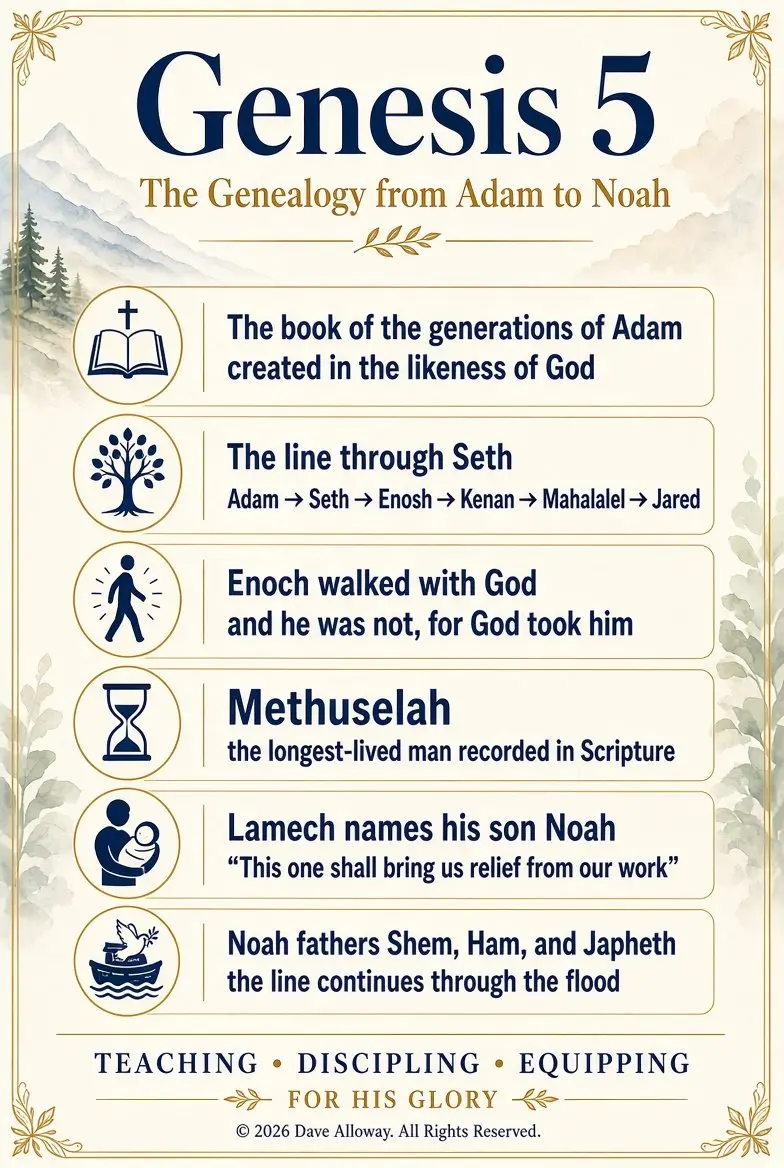
Genesis 5: The Genealogy from Adam to Noah

Genesis 5

Chapter With Audio

Adam's Descendants to Noah

5 This is the book of the generations of Adam. When God created man, he made him in the likeness of God. 2 Male and female he created them, and he blessed them and named them Man when they were created. 3 When Adam had lived 130 years, he fathered a son in his own likeness, after his image, and named him Seth. 4 The days of Adam after he fathered Seth were 800 years; and he had other sons and daughters. 5 Thus all the days that Adam lived were 930 years, and he died.

6 When Seth had lived 105 years, he fathered Enosh. 7 Seth lived after he fathered Enosh 807 years and had other sons and daughters. 8 Thus all the days of Seth were 912 years, and he died.

9 When Enosh had lived 90 years, he fathered Kenan. 10 Enosh lived after he fathered Kenan 815 years and had other sons and daughters. 11 Thus all the days of Enosh were 905 years, and he died.

12 When Kenan had lived 70 years, he fathered Mahalalel. 13 Kenan lived after he fathered Mahalalel 840 years and had other sons and daughters. 14 Thus all the days of Kenan were 910 years, and he died.

15 When Mahalalel had lived 65 years, he fathered Jared. 16 Mahalalel lived after he fathered Jared 830 years and had other sons and daughters. 17 Thus all the days of Mahalalel were 895 years, and he died.

18 When Jared had lived 162 years, he fathered Enoch. 19 Jared lived after he fathered Enoch 800 years and had other sons and daughters. 20 Thus all the days of Jared were 962 years, and he died.

21 When Enoch had lived 65 years, he fathered Methuselah. 22 Enoch walked with God after he fathered Methuselah 300 years and had other sons and daughters. 23 Thus all the days of Enoch were 365 years. 24 Enoch walked with God, and he was not, for God took him.

25 When Methuselah had lived 187 years, he fathered Lamech. 26 Methuselah lived after he fathered Lamech 782 years and had other sons and daughters. 27 Thus all the days of Methuselah were 969 years, and he died.

28 When Lamech had lived 182 years, he fathered a son 29 and called his name Noah, saying, “Out of the ground that the Lord has cursed, this one shall bring us relief from our work and from the painful toil of our hands.” 30 Lamech lived after he fathered Noah 595 years and had other sons and daughters. 31 Thus all the days of Lamech were 777 years, and he died.

32 After Noah was 500 years old, Noah fathered Shem, Ham, and Japheth.

Chapter Analysis
Analysis

Genesis 5: From Adam to Noah

Scripture Reference: Genesis 5:1–32 (ASV)

The Scripture (key verses, exact ASV)

¹This is the book of the generations of Adam. In the day that God created man, in the likeness of God made he him; ²male and female created he them, and blessed them, and called their name Adam, in the day when they were created. ³And Adam lived a hundred and thirty years, and begat [a son] in his own likeness, after his image; and called his name Seth:

⁵And all the days that Adam lived were nine hundred and thirty years: and he died.

²²and Enoch walked with God after he begat Methuselah three hundred years, and begat sons and daughters: ²³and all the days of Enoch were three hundred sixty and five years: ²⁴and Enoch walked with God: and he was not; for God took him.

²⁹and he called his name Noah, saying, This same shall comfort us in our work and in the toil of our hands, [which cometh] because of the ground which Jehovah hath cursed.

The Genealogy at a Glance

All numbers are taken directly from the ASV text. The ASV follows the Hebrew text; the Greek Septuagint gives different figures for some of these ages.

NameAge at son’s birthYears lived afterTotal yearsSon named
Adam 130 800 930 Seth
Seth 105 807 912 Enosh
Enosh 90 815 905 Kenan
Kenan 70 840 910 Mahalalel
Mahalalel 65 830 895 Jared
Jared 162 800 962 Enoch
Enoch 65 300 365 (God took him) Methuselah
Methuselah 187 782 969 Lamech
Lamech 182 595 777 Noah
Noah 500 — — Shem, Ham, Japheth

A Repeated Pattern

Each entry follows the same form:

  1. He lived a certain number of years and fathered a named son.
  2. He lived a further number of years and had sons and daughters.
  3. All his days totaled a certain number, “and he died.”

That last phrase appears eight times (vv. 5, 8, 11, 14, 17, 20, 27, 31). It sounds like a funeral bell through the chapter. God’s warning in 2:17 and His sentence in 3:19 came true for every one of them except Enoch.

Explanation

Verses 1–2: A link back to creation. The chapter opens by repeating the truth of 1:26–28. Man was made in God’s likeness, male and female, and blessed. “Adam” here names the human race (“called their name Adam”) as well as the first man.

Verse 3: The image passed on. Adam fathered Seth “in his own likeness, after his image.” Mankind still bears God’s image (Genesis 9:6; James 3:9). But Seth was born to a fallen father, after the events of chapter 3, and inherited his father’s condition.

Verses 3–20: Long lives, but real deaths. These men lived for centuries, and the text presents those ages as actual life spans. Long lives did not overcome the sentence of death. Every man listed died, with one exception.

Verses 21–24: Enoch, the exception. Three things are said about Enoch:

  • He walked with God. This is stated twice (vv. 22, 24). It describes ongoing fellowship and obedience, not a single moment. His walk is mentioned after Methuselah’s birth, during ordinary family life.
  • “He was not; for God took him.” Enoch is the only man in the chapter for whom “and he died” is not written. Hebrews 11:5 says he was taken so that he should not see death, and that he pleased God.
  • He was seventh from Adam. Jude 14 notes this. Compare Lamech, seventh from Adam through Cain (4:23–24), who boasted of killing a man. The two lines produced opposite men in the same generation.

Verse 27: Methuselah. At 969 years, he lived longer than anyone else recorded in Scripture.

Verses 28–29: Lamech’s hope. This Lamech, from Seth’s line, is very different from Cain’s descendant in chapter 4. He names his son Noah, saying that this son will bring comfort from the toil caused by “the ground which Jehovah hath cursed.” He remembered God’s judgment in 3:17, and he looked to God for relief through his son.

Verse 32: Noah and his sons. The genealogy ends with Noah at 500 years old and his three sons. This sets the stage for the flood account that begins in chapter 6.

What the Numbers Show

Adding the ages at each son’s birth gives the following timeline, based only on the ASV numbers:

  • Adam overlapped Lamech. Lamech was born in year 874 of the genealogy; Adam died in year 930. Adam’s life overlapped every man listed down to Lamech, Noah’s father.
  • Methuselah died in the flood year. Noah was born in year 1056. The flood came in Noah’s 600th year (7:6), which is year 1656. Methuselah’s 969 years also end in year 1656. The text does not say how he died, only that the timing coincides.
  • Lamech died before the flood. His 777 years end in year 1651, five years earlier.

Supporting Scripture

These are references only. I have not quoted them, so please check the ASV wording before publishing.

  • 1 Chronicles 1:1–4 — the same line from Adam to Noah’s sons.
  • Luke 3:36–38 — Christ’s genealogy traced through these names back to Adam, “the son of God.”
  • Hebrews 11:5–6 — Enoch was translated and had witness that he pleased God; without faith it is impossible to please Him.
  • Jude 14–15 — Enoch, seventh from Adam, prophesied the Lord’s coming in judgment.
  • Romans 5:12, 14 — death passed to all men; death reigned from Adam to Moses.
  • 1 Corinthians 15:22 — in Adam all die; in Christ all shall be made alive.
  • Hebrews 9:27 — it is appointed unto men once to die.
  • Genesis 6:9 — Noah, like Enoch, walked with God.

Conclusion

Genesis 5 establishes several things:

  • God preserved a line from Adam through Seth to Noah, recorded by name and by years.
  • Men continued to bear God’s image, but they also inherited Adam’s fallen condition.
  • Death came to every generation, as God had said, regardless of long life spans.
  • Enoch walked with God and was taken by God without dying, showing that fellowship with God was still possible in a fallen world.
  • Lamech named Noah in hope that God would bring relief from the curse.

The chapter is more than a list of names. It shows the reign of death since Eden, and it shows God keeping His promised line alive until the time of Noah.


The verses quoted above were checked against the ASV text at Sacred Texts. The timeline figures are my calculations from the ASV numbers, so they are worth rechecking before publishing.

Sources: American Standard Version: Genesis (Sacred Texts)