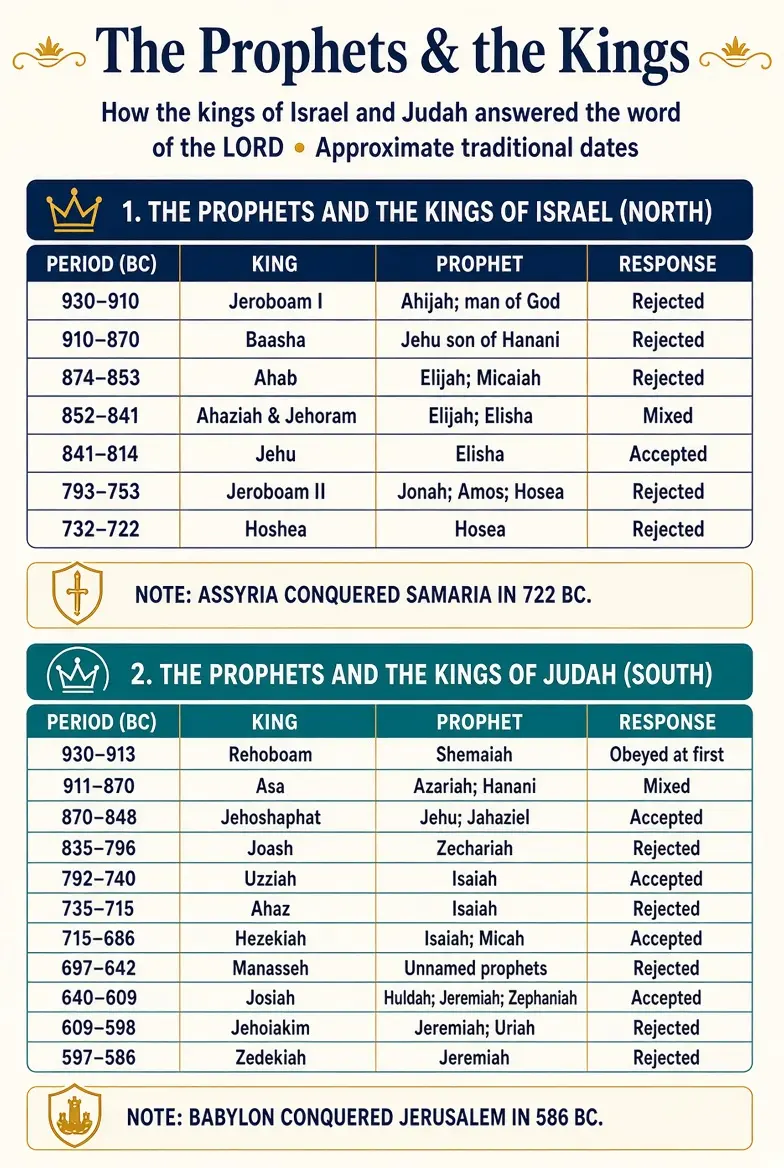
Throughout the books of Samuel, Kings, and Chronicles, God sent prophets to the kings of Israel and Judah. They anointed kings, guided them, rebuked them, and warned them of judgment. The story of the two kingdoms is largely the story of how each king answered the word of the LORD.
The Role of the Prophet
A prophet in Israel was not a political adviser or a fortune-teller. He was God's spokesman and the enforcer of the covenant given at Sinai. When kings kept the covenant, the prophets confirmed God's blessing. When kings broke it, the prophets called them back, and if they refused, announced the covenant curses that Moses had warned about in Deuteronomy.
This pattern began with the monarchy itself. Samuel anointed Saul and then declared his rejection for disobedience (1 Samuel 13, 15). Samuel then anointed David (1 Samuel 16). Nathan delivered the covenant promise to David (2 Samuel 7) and later confronted him over Bathsheba and Uriah (2 Samuel 12). Gad pronounced judgment after David's census (2 Samuel 24). From the beginning, the king stood under the word of God.
The Kingdom Divides
After Solomon's death, the kingdom split around 930 BC. Ten tribes formed the northern kingdom of Israel, and Judah, with the line of David, formed the southern kingdom. The prophet Ahijah had told Jeroboam this would happen because of Solomon's idolatry (1 Kings 11). Prophets worked in both kingdoms until the north fell to Assyria in 722 BC and the south fell to Babylon in 586 BC.
All dates in this article are approximate and follow a traditional chronology. Scholars differ on some of them.
The Prophets and the Kings of Israel (North)
| Period (BC) | King | Prophet | The Encounter | Response |
|---|---|---|---|---|
| 930-910 | Jeroboam I | Ahijah; a man of God from Judah | Ahijah foretold his rise, then judgment on his calf worship (1 Kin 11-14). | Rejected |
| 910-870 | Baasha | Jehu son of Hanani | Announced the end of Baasha's house (1 Kin 16). | Rejected |
| 874-853 | Ahab | Elijah; Micaiah | Elijah called the drought, confronted the prophets of Baal at Carmel, and condemned the seizure of Naboth's vineyard. Micaiah foretold defeat at Ramoth-gilead (1 Kin 17-22). | Rejected |
| 852-841 | Ahaziah and Jehoram | Elijah; Elisha | Elijah announced Ahaziah's death. Elisha gave military guidance to Jehoram and delivered Samaria (2 Kin 1, 3-7). | Mixed |
| 841-814 | Jehu | Elisha (through a young prophet) | Jehu was anointed to destroy the house of Ahab (2 Kin 9). | Accepted the commission |
| 793-753 | Jeroboam II | Jonah; Amos; Hosea | Jonah foretold the kingdom's expansion. Amos and Hosea denounced injustice and idolatry (2 Kin 14; Amos; Hosea). | Rejected |
| 732-722 | Hoshea | Hosea | Called Israel to return before Assyria conquered Samaria (Hosea; 2 Kin 17). | Rejected |
No king of the northern kingdom turned the nation back to the LORD. Assyria conquered Samaria in 722 BC, and 2 Kings 17 states plainly that the people had ignored the prophets who warned them.
The Prophets and the Kings of Judah (South)
| Period (BC) | King | Prophet | The Encounter | Response |
|---|---|---|---|---|
| 930-913 | Rehoboam | Shemaiah | Forbade war with the northern tribes, and later explained the Egyptian invasion (1 Kin 12; 2 Chr 12). | Obeyed at first |
| 911-870 | Asa | Azariah; Hanani | Azariah spurred reform. Hanani rebuked Asa for relying on Syria rather than the LORD (2 Chr 15-16). | Mixed |
| 870-848 | Jehoshaphat | Jehu; Jahaziel | Jehu rebuked his alliance with Ahab. Jahaziel assured him of victory (2 Chr 19-20). | Accepted |
| 835-796 | Joash | Zechariah son of Jehoiada | Rebuked the king for idolatry and was put to death (2 Chr 24). | Rejected |
| 792-740 | Uzziah | Isaiah | Isaiah's call came in the year Uzziah died (Isa 6). | Accepted |
| 735-715 | Ahaz | Isaiah | Offered the Immanuel sign and urged trust in God rather than Assyria (Isa 7). | Rejected |
| 715-686 | Hezekiah | Isaiah; Micah | Isaiah assured him of deliverance from Assyria and warned of Babylon's future rise (2 Kin 19-20; Jer 26:18). | Accepted |
| 697-642 | Manasseh | Unnamed prophets | Announced coming judgment for the king's wickedness (2 Kin 21). | Rejected |
| 640-609 | Josiah | Huldah; Jeremiah; Zephaniah | Huldah confirmed the newly found Book of the Law, and Josiah led a national reform (2 Kin 22-23). | Accepted |
| 609-598 | Jehoiakim | Jeremiah; Uriah | Jehoiakim burned Jeremiah's scroll and had Uriah executed (Jer 26, 36). | Rejected |
| 597-586 | Zedekiah | Jeremiah | Jeremiah urged surrender to Babylon and was imprisoned (Jer 21, 37-38). | Rejected |
What the Pattern Shows
1. The prophets spoke to both kingdoms
God did not abandon either kingdom. He sent a steady stream of prophets to the north and to the south, and in both places the message was the same: return to the covenant.
2. A king's response determined the nation's direction
Under Jehoshaphat, Hezekiah, and Josiah, Judah saw reform and deliverance. Under Ahaz, Manasseh, and Zedekiah, it moved toward judgment. The northern kingdom, whose kings consistently rejected the prophets, fell first.
3. Rejecting the messenger did not change the message
Ahab hated Elijah and Micaiah, Joash killed Zechariah, and Jehoiakim burned Jeremiah's scroll. In each case the word of the LORD came to pass anyway. Silencing a prophet never silenced the covenant.
4. The prophets also pointed beyond the kings
Even as they confronted failing kings, the prophets promised a coming King from David's line. Isaiah foretold a child who would sit on David's throne (Isaiah 9). Micah named Bethlehem as his birthplace (Micah 5). Jeremiah promised a New Covenant (Jeremiah 31). The failure of Israel's kings was part of what pointed forward to the perfect King.
Key Takeaways
- Prophets anointed, guided, rebuked, and warned the kings of both kingdoms.
- Kings who heeded the prophets (David, Hezekiah, Josiah) brought blessing and reform.
- Kings who resisted them (Ahab, Manasseh, Jehoiakim, Zedekiah) brought judgment.
- The northern kingdom fell in 722 BC and Judah in 586 BC, as the prophets had warned.
- The prophets pointed to a coming King who would succeed where the kings of Israel and Judah failed.
Scripture for Further Study
1 Samuel 13-16; 2 Samuel 7, 12, 24; 1 Kings 11-22; 2 Kings 1-25; 2 Chronicles 12-24; Isaiah 6-7, 37-39; Jeremiah 26, 36-38; Amos; Hosea; Micah.